Thirteenth Lake
LakeMonster AI fishing reportFirst stop
S1 — the narrow inlet opening (bay mouth), upper-right on the Oct 21 image. Inlet mouths concentrate current, incoming (slightly warmer on sunny afternoons) water, and any food the west wind funnels. Position outside the mouth, fan-cast across the opening and along both visible shoreline shoulders, working the shallow-to-mid depth band — test roughly the first 8–15 feet as a hypothesis, since no bathymetry exists. First cast direction: straight across the mouth, then parallel to each shoulder. Target the visible transition where open water meets the narrower inlet throat. Deadline: if no follow, bump, or hookup by 11:25 AM, move. On-water check at arrival: dip a thermometer or note surface chop and any visible sediment plume at the mouth — that plume is your clarity and current clue.
Backup area
S2 — the mid-lake shoreline bend (center of the Oct 21 image). A bend in the shoreline is the next-most-likely current seam and wind-collection shape after the inlet mouth. Move by 11:25 AM if S1 produced nothing. Keep the same spinner for the first 10 minutes there; change to the hair jig only on the follow-no-eat trigger. Cast parallel to the visible bend edge rather than assuming which flank is sheltered — read the calmer side on arrival. This backup resolves the failed assumption at S1 (that the inlet mouth was concentrating fish); if fish aren't using the mouth, the nearest major directional shoreline change is the logical next seam, and it's a short relocation rather than a crossing.
When to move
- No contact by 11:25: relocate to S2 as above; if S2 is also dead by 12:25, slow down further (hair jig, longer pauses) rather than relocating again — cold high-pressure fish rarely chase.
- Follows, no eats: switch to the hair jig immediately; do not wait out the full 25 minutes.
- Unexpected reading: if the water is visibly stained or the surface feels warmer than the low-40s seasonal read suggests, speed the spinner up one notch and shorten casts to the visible shallow band.
- Wind worsening (gusts building past the forecast 14–16 mph and boat control suffering): slide to the visibly calmer side of the shape you're fishing — that's an adjustment, not a relocation.
- Thunder or lightning: end the trip immediately, no last pass.
The call
The lake-local day was nearly spent when this plan was built, so this is Thursday, November 19, 2026 plan for Thirteenth Lake (Warren County, NY). Target: brook trout, fished slow and shallow along visible shoreline structure. Primary window: 11:00 AM – 12:00 PM, backup window 12:00 – 1:00 PM, both America/New York. First stop: the S1 bay mouth (narrow inlet opening, upper-right on the October 21, 2026 satellite image). Starter bait: #1-blade inline spinner, silver blade with a black body, 4–6 lb mono on a light spinning rod, retrieved just fast enough to turn the blade, with a 2–3 second pause after each cast lands. This beats the plausible alternative — trolling or jigging for lake trout — because a 335-acre late-fall lake with a stale 51°F reading (Oct 30) is almost certainly in the low 40s now; brook trout stay reachable from shore or a small boat at shallow shoreline depths in that season, while laker depths and exact bottom structure here are unmeasured and would be a blind guess.
Read the water
- Temperature: The lake-page value is 51°F, timestamped Oct 30, 2026 — 471 hours old, so it is stale and supports only a seasonal read, not a current number. The historical series is cooling, −2.0°F over its last 2 readings (range 51.2–53.3°F). My read: the lake is likely in the low-to-mid 40s now, late-fall mode, with fish holding near shore in the warmest afternoon water. I will not quote a new measured temperature — the on-water check below is the fix.
- Wind: Forecast is west wind 3.7 mph at 8 AM building to 5.4 mph by 11 AM (gusts 12.8), 6.4 mph at noon (gusts 14.3). Wind from the west blows toward the east, so the east side takes the breeze and any surface food it pushes. The satellite image has no resolved compass orientation, so pick the visibly wind-chopped side on arrival rather than assuming which named shore faces east.
- Sky/pressure: Clear to partly cloudy, high of 55°F, pressure ~1028 mb and high — stable, cold-front-adjacent conditions. That argues for a slow, small, subtle presentation, not a fast reaction bait.
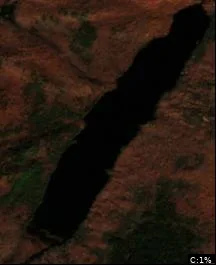
- Imagery: The natural satellite frame (captured Oct 21, 2026) is usable for shoreline geometry only: S1 narrow inlet opening (upper right), S2 mid-lake shoreline bend (center), S3 lower-left shoreline point. The thermal capture (Oct 29, 2026) has unreliable palette calibration — one dominant blue-cyan zone covering essentially the whole frame — so it gives no usable warm/cool ranking and I exclude it from today's decisions. Clarity data is undated archive only; current visibility is unverified, so start conservative (small, natural/metallic profile) and adjust on arrival.
- Reports: No community reports in the past 7 days — the plan runs on forecast, season, and structure, not recent intel.
First stop
S1 — the narrow inlet opening (bay mouth), upper-right on the Oct 21 image. Inlet mouths concentrate current, incoming (slightly warmer on sunny afternoons) water, and any food the west wind funnels. Position outside the mouth, fan-cast across the opening and along both visible shoreline shoulders, working the shallow-to-mid depth band — test roughly the first 8–15 feet as a hypothesis, since no bathymetry exists. First cast direction: straight across the mouth, then parallel to each shoulder. Target the visible transition where open water meets the narrower inlet throat. Deadline: if no follow, bump, or hookup by 11:25 AM, move. On-water check at arrival: dip a thermometer or note surface chop and any visible sediment plume at the mouth — that plume is your clarity and current clue.
Rig and retrieve
Starter: #1 inline spinner, silver blade, black body, 4–6 lb mono, light spinning rod. Cast across the mouth, let it sink 2–3 seconds, retrieve just fast enough to keep the blade turning, with a one-second stall every few handle turns. Slow cadence matches cold water and high pressure; silver gives flash in unverified-but-likely clear Adirondack water. Backup presentation: same rod, switch to a small 1/16–1/8-oz marabou or hair jig in black or olive, slow-hopped along bottom — trigger to change: fish following the spinner without committing, or the water reading clearer than expected.
Fishing window
- Primary window: 11:00 AM – 12:00 PM — wind 5.4 mph W (gusts 12.8) at 11 AM, 6.4 mph (gusts 14.3) at noon, mostly clear, air 50→53°F. This overlaps the 8:21–10:51 AM major solunar period's tail and the entire first stop runs here.
- Backup window: 12:00 – 1:00 PM — 7.2 mph WSW (gusts 16.1) at 1 PM, clear, 54°F; the 12:47–2:17 PM minor solunar period begins inside it.
- Sequence: on water and casting at S1 by 11:00 → 25-minute trial → move at 11:25 if dead → fish the adjacent S1 shoulder or shift to the backup through noon → finish by 1:00 PM. Sunset is 4:28 PM but the plan ends at the backup window's close; the 6:32–9:02 PM solunar period is after dark-adjacent cold and outside the requested daylight window, so it is not used.
Backup area
S2 — the mid-lake shoreline bend (center of the Oct 21 image). A bend in the shoreline is the next-most-likely current seam and wind-collection shape after the inlet mouth. Move by 11:25 AM if S1 produced nothing. Keep the same spinner for the first 10 minutes there; change to the hair jig only on the follow-no-eat trigger. Cast parallel to the visible bend edge rather than assuming which flank is sheltered — read the calmer side on arrival. This backup resolves the failed assumption at S1 (that the inlet mouth was concentrating fish); if fish aren't using the mouth, the nearest major directional shoreline change is the logical next seam, and it's a short relocation rather than a crossing.
Switch or stop
- No contact by 11:25: relocate to S2 as above; if S2 is also dead by 12:25, slow down further (hair jig, longer pauses) rather than relocating again — cold high-pressure fish rarely chase.
- Follows, no eats: switch to the hair jig immediately; do not wait out the full 25 minutes.
- Unexpected reading: if the water is visibly stained or the surface feels warmer than the low-40s seasonal read suggests, speed the spinner up one notch and shorten casts to the visible shallow band.
- Wind worsening (gusts building past the forecast 14–16 mph and boat control suffering): slide to the visibly calmer side of the shape you're fishing — that's an adjustment, not a relocation.
- Thunder or lightning: end the trip immediately, no last pass.
Before you launch
Rig one rod with the silver/black #1 spinner and tie on the black hair jig as a pre-tied backup. Arrival checks: actual wind direction on the water (which side is chopped), any sediment plume at the S1 mouth, and — the single most valuable check — a fresh surface temperature reading, because the only water-temperature evidence is the stale 51°F value from Oct 30 and a cooling trend; one thermometer dip converts the whole depth-and-cadence plan from seasonal guess to measured fact. Shore-adaptation: if launching is uncertain, fish the S1 mouth from the nearest accessible shoreline on the same clock — but verify legal public access; the imagery shows no access points. Ranked next days: Thursday Nov 19 best (calm morning, warming afternoon), Friday Nov 20 second (similar pattern, 2/5 solunar, majors overnight), Wednesday Nov 18 last (day already spent). What would change the choice: a fresh water reading well below 40°F would push the plan toward deeper, slower jigging; a strong report of recent rainbow activity would swap the spinner for small spoons on the same structure.
Sources behind this plan (10)
LakeMonster AI generated this plan from the sources below. Each source carries its own observation or forecast date.
Water temperatureView details
Water temperature trend for Thirteenth Lake: cooling; -2.0°F over 2 readings; Lake-page surface-water value: 51°F, timestamped 2026-10-30T12:00:00+00:00; it is 426 hours old and stale for a current-conditions decision.
SpeciesView details
Species behavior analysis for Thirteenth Lake completed
SolunarView details
Solunar timing hypotheses for Thirteenth Lake on 2026-11-18
Solunar periods do not measure feeding, fish activity, catches, depth, or location.
Hourly forecastView details
Hour-by-hour forecast control conditions for Thirteenth Lake on 2026-11-19 (America/New York)
WeatherView details
Weather analysis for Thirteenth Lake on 2026-11-18: moderate wind, stable pressure
TackleView details
Select a listed target species before generating tackle guidance; the lake catalog order is not a user selection.
No measured clarity or current dated clarity imagery is available; using a conservative starting presentation
Recent catchesView details
Community reports for Thirteenth Lake over the past 7 days
No reports in last 7 days
Water clarityView details
Archived MCI/TSS provides arrival checks only. Current clarity is unverified.
Archived MCI/TSS provides arrival checks only. Current clarity is unverified.
ThermalView details
Thermal capture retained as historical visual context for Thirteenth Lake; do not use it as today's temperature pattern. Lake-page surface-water value: 51°F, timestamped 2026-10-30T12:00:00+00:00; it is 471 hours old and stale for a current-conditions decision.
Do not infer depth or bottom structure from surface thermal colors.
The lake-page value of 51°F is stale and should be used only as a reference point.
Thermal patterns may be influenced by surface wind or recent weather not captured here.
SatelliteView details
Image quality: usable — Visible shoreline geometry and distinct lake shape are clearly identifiable despite low resolution and lack of geospatial metadata. S1 | bay mouth | Observed: narrow inlet opening | Position: upper right | Scale: unknown | Evidence: shoreline geometry (85% visual confidence) S2 | bend | Observed: mid lake shoreline curvature | Position: center | Scale: unknown | Evidence: shoreline geometry (80% visual confidence) S3 | point | Observed: lower left shoreline projection | Position: lower left | Scale: unknown | Evidence: shoreline geometry (75% visual confidence) S1 | Derived: Use this visible shape as a candidate shoreline search area. Because: narrow inlet opening Verify: Check access, actual wind exposure and visible water movement at this shape. S2 | Derived: Use this visible shape as a candidate shoreline search area. Because: mid lake shoreline curvature Verify: Check access, actual wind exposure and visible water movement at this shape. S3 | Derived: Use this visible shape as a candidate shoreline search area. Because: lower left shoreline projection Verify: Check access, actual wind exposure and visible water movement at this shape. Limitation: no depth data Limitation: no bathymetry Limitation: no submerged structure Limitation: no orientation Limitation: no scale Limitation: no access points
no depth data
no bathymetry
no submerged structure
LakeMonster AI
Turn the lake into a fishing plan
Forecast read: Go sheltered · 6 AM. Use the imagery, weather, and listed species to choose your first area and when to move.
First area, exact setup, best window, and a backup.
Sign in or create a free account to use the quick questions. Building a plan and asking your own question are Pro.
Compare the next 3 days, scout imagery, and build a backup pattern.
8 sources for this lake
- Current water temp
- 51°F
- Water temp history
- 435 readings
- Hourly weather
- 224 hours
- Solunar timing
- 2/5
- Fish species
- 16 listed
- Satellite imagery
- 232 captures
- Thermal imagery
- 1256 captures
- Map structure
- available
Latest source update: Nov 27, 1:23 PM EST. Each image and reading has its own date.